Capital Projects Yield Condensate Savings
Three completed capital projects and two projects currently in the design stage will complete refurbishment of the condensate line for the District Energy System.
The condensate return line is a major component of the District Energy System. It carries hot water that results from steam condensing during the heat transfer process back to the District Energy Plant. The condensate lines were in pretty bad shape prior to the refurbishment projects that started several years ago.
As a closed system, the hot water being returned to the plant is important because it is reheated in the steam generation process and uses less energy than cold water that otherwise has to be added to the system. Condensate comes back to the plant at about 170 degrees F as opposed to 60 degree city water that would have to be used instead. Prior to the work on the system, less than 1% of the condensate was making it back to the plant. Now, 60% to 70% is returned. The result is significant energy and water savings in the overall operation of the system.
Pesky Leak Discovered and Repaired
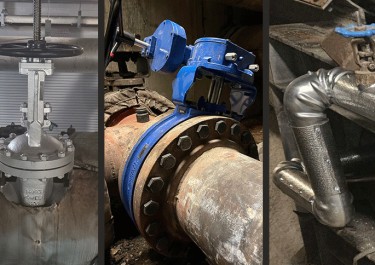
A sonic listening device operated by Metro Water detected a chilled water leak that has eluded CEPS for more than a year. Located near 3rd Avenue North and Deaderick, the leak was discovered and repaired as a result of the cooperative effort between Metro Water and CEPS. CEPS employees had attempted to locate the leak for more than a year but the volume of water was not sufficient enough to create visible evidence. A corroded valve fitting on an abandoned bleed line used to bleed air off the system during installation was the cause of the leak. Since abandonment, the line was buried below ground.
DES officials knew of the leak because additional water had to be added to the closed system. While the volume of water required was not a significant cost issue, the ongoing addition of water also required treating the new water with chemicals to reduce corrosion and prevent solids buildup.
"This ends a long and frustrating search," said Mike Bradley. "It is good to have this item off our agenda."
DES Paying Dividends, Subsidies Continue to Shrink
The Metro Finance Department recently reported that the Metro DES facility provides the city with significant value. An audit released by the department found that the facility's value comes from declining subsidy and solid waste costs, combined with a more efficient energy source.
The Metro Nashville District Energy System (DES) provides energy for heating and air conditioning of nearly 40 buildings in downtown Nashville. The city has used district energy services for three decades, pioneering the waste-to-energy method of district energy in the early 1970s via the Nashville Thermal Transfer Corporation (Thermal).
The DES facility replaced the aged Thermal facility in January 2004 to provide its customers with more reliable, efficient, cost-effective and environmentally friendly heating and cooling.
Fast Facts:
- Steam and chilled water are pumped to the buildings through 26,000 feet – or five miles – of underground pipes.
- The facility operates nine chillers and four boilers, and has the capacity to provide 23,400 tons of chilled water for cooling and 260,000 pounds of steam for heating.
- The largest pipe in the DES system measures 42 inches in diameter; the smallest is only a half inch.
DES circulates roughly 2 million gallons of chilled water at any given time. - Each minute, up to 42,000 gallons of chilled water are pumped through the system.
- Steam travels through the pipes to downtown buildings at an average rate of 70 miles per hour.
- Nearly 100% of the water used for chilled water cooling is recycled, while only 30 percent of the water used for steam is new water, and 70 percent is recycled.
- DES employs 24 people
- Visit the links to the left to learn more about the Metro Nashville DES.