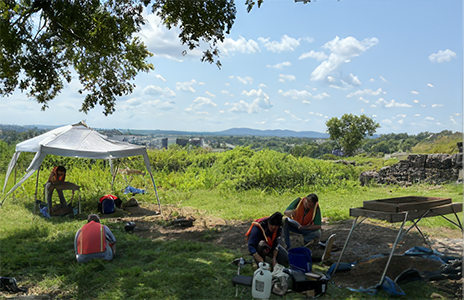
Nashville Public Archaeology Program excavating at Ft. Negley ahead of its renovation
Metropolitan Nashville and Davidson County, Tennessee, contain hundreds of thousands of archaeological sites. These sites span over 14,000 years of history and are the record of the many peoples that have called Nashville home.
The Metropolitan Historical Commission (MHC) is committed to documenting this record through archaeology and preserving this rich heritage. Archaeology is the systematic and scientific study of the past through material culture or the things people have left behind. Archaeologists employ a scientific process to record the location of objects on the landscape and in soil layers. This method allows archaeologists to be able to date artifacts and soil layers and link artifacts with people. Uncontrolled digging, such as the digging for relics, can destroy the archaeological record and should be avoided.
Digging on Metro property, including park lands, is prohibited. [Metro Code 11.24.110]
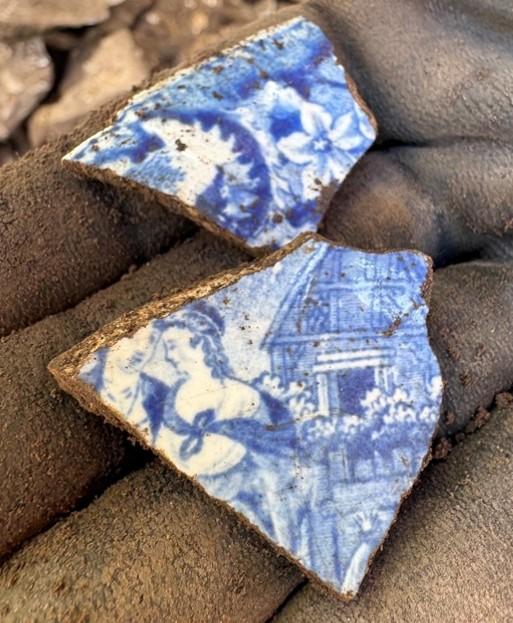
Transfer-printed ceramic excavated adjacent to the Croft House at the Nashville Zoo.
Archaeology is the study of the human past through material culture, spanning from millions of years ago to the recent past. Material culture can be anything that people have created, modified, or used. These objects include both artifacts (portable remains like tools) and features (non-portable remains such as pits or building foundations). Artifacts and features can help archaeologists understand how people lived, what they ate, how they organized their societies, what they believed, and more.
Archaeology is a subfield of anthropology, or the study of humanity, and is an interdisciplinary field. Archaeologists draw on the knowledge of other forms of anthropology, such as cultural or biological anthropology, to better understand people in the past. Archaeologists also incorporate methods from other fields, such as geology or history, to inform their study. Most importantly, archaeologists investigate past peoples scientifically, formulating research questions, testing hypotheses, and collecting and interpreting data to reconstruct their lives.
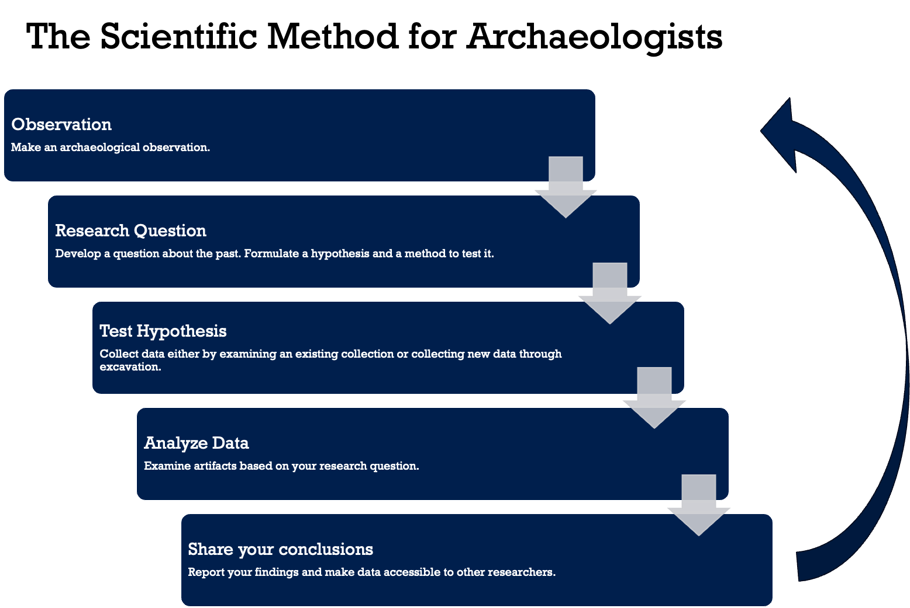
Archaeology encompasses more than just digging for artifacts of interest. The Metropolitan Historical Commission undertakes all projects with the ultimate goal of preserving Davidson County’s cultural heritage for future generations and making this data accessible. An integral part of this process is using the scientific method, a process of formulating and testing questions (hypotheses).
Step 1: Make an Observation
Archaeologists make an observation about archaeological sites and artifacts based on several considerations. They examine land use, site disturbance, the locations of nearby resources, topography, and historical sources when evaluating the potential for archaeological resources or when conducting research.
Step 2: Formulate a Research Question
From their observations, archaeologists start with a question about people in the past. They conduct research and develop that question into a hypothesis. The hypothesis shapes the methods they use to collect and analyze data.
Step 3: Test the Hypothesis
Archaeologists must then examine evidence to support or reject their hypothesis. This evidence exists in the artifacts and the detailed field records. Archaeologists can examine existing archaeological collections or carefully and scientifically excavate to collect more data.
Step 4: Analyze Data
An archaeologist’s work does not end with the dig. For every day in the field, archaeologists typically spend at least three days in the lab analyzing what they found. They start by carefully cleaning the dirt off of artifacts and labeling them with the provenience in which they were found. Provenience is an object’s three-dimensional location in space. Artifacts are then sorted, cataloged, and analyzed to test the hypothesis and answer the overall research question.
Archaeologists must properly curate the collections and records from the excavation. This step is crucial, as it allows future archaeologists to study the collection and re-test the hypothesis or ask new questions.
Step 5: Share Conclusions
In the reporting stage, archaeologists synthesize their findings and interpret them to provide a window into the lives of many people from the past. These findings are often written into reports, many of which are available to the public, adding to a growing repository of Nashville’s cultural history.
Archaeological sites provide us with a better understanding of the past and the present. Through careful excavation of the soil and material that has been left behind, we can begin to piece together this history. For many in Nashville, their story is not found in history books or historical records. Instead, the material that they left behind is often the only record of their lives.
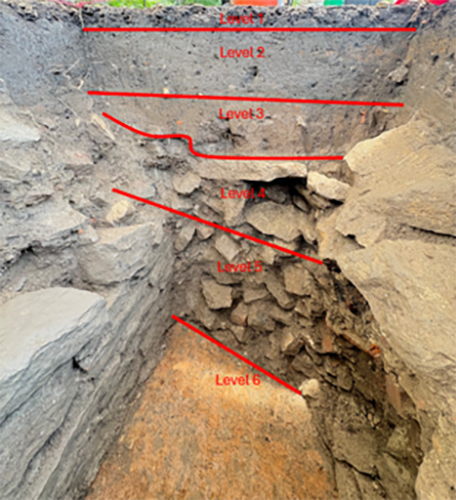
Soil levels filling the root cellar of a building that sat next to the Croft House at the Nashville Zoo
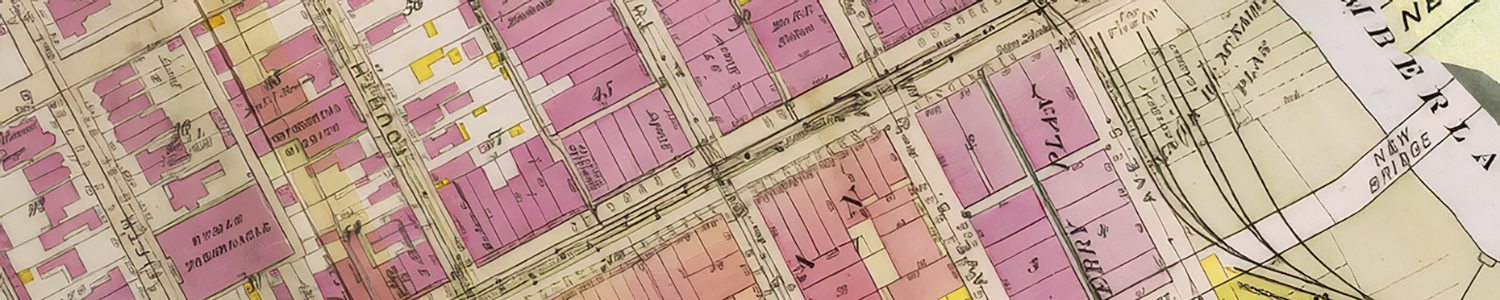
The Metropolitan Historical Commission reviews the potential impacts of projects on archaeological resources, largely through development projects with recommendations made to the Planning Department. Projects are evaluated based on known registered archaeological sites and the potential for archaeological sites. Land use, site disturbance, nearby resources, and topography are some of the factors used in evaluating the potential for archaeological resources.
Based on known or potential archaeological resources, the Metropolitan Historical Commission may recommend documentation and/or different levels of excavation. The Tennessee Division of Archaeology maintains a list of archaeological contractors who can conduct this work.
The Metropolitan Historical Commission (MHC) also partners with state and federal agencies on projects affecting archaeological resources in Metro Nashville. With regulations such as Section 106 of the National Historic Preservation Act, the MHC serves as a consultant, helping to identify resources and propose appropriate mitigation measures.
Not all projects require review of the MHC. Therefore, the public is encouraged to look out for archaeological resources and notify the MHC if resources are being threatened or destroyed. By working together, we can better preserve the past and safeguard this heritage.
Levels of Excavation
Type
Objective
Methods
Phase I
Locate and identify the type and boundaries of a site
Historical research, surface survey, trenching, shovel test pits, and soil boring
Phase II
Define the site and evaluate its integrity
Trenching, shovel test pits, soil boring, and excavation units
All methods seek to uncover and document archaeological resources in a controlled and scientific manner. Methods are often tailored to the specific research goals and the condition and settings of a property.
Surface Survey
A surface survey is a systematic walk-over survey of ground surfaces with high soil visibility, such as recently plowed fields. A surface survey can help quickly locate artifact concentrations.
Shovel Test Pits (STPs)
Shovel Test Pits are small test pits dug stratigraphically with a shovel. Shovel Test Pits are dug in a grid at set intervals to maximize the coverage of a test area. Shovel Test Pits can be an effective method for testing large areas with cultural deposits less than a meter in depth. Shovel Test Pits are NOT an effective testing strategy for many urban areas, especially deep deposits, alluvial soils, or areas with fill.
Excavation Units
Excavation units are usually square or rectangular-shaped, excavated by hand, and are used in a grid to excavate an area stratigraphically.
Trenching
Trenching allows for sampling of a larger area by exposing soil stratigraphy and locating deeper deposits. Trenches can be excavated by hand or machine. Trenching can be an effective strategy to excavate in developed or urban settings where resources may be deeper or lie beneath fill layers.
Soil Boring
Soil boring is used to study soil stratigraphy and locate cultural layers in deeper deposits that are difficult to excavate by hand. Soil boring can be useful with soils on floodplains or in urban settings. Soil boring is usually a preliminary testing strategy.
Mechanical Soil Stripping
In areas with disturbance or where a large surface needs to be exposed, an excavator is used to remove layers of soil to expose cultural layers below. Soil stripping can be used in developed or urban areas or areas that have a plowzone from agriculture.
Resources
The Metro Historical Commission is committed to preserving the archaeological heritage of Davidson County. Please contact staff archaeologist Adam Fracchia with any questions or concerns or if you are interested in participating in the public archaeology program.
Additionally, the Tennessee Division of Archaeology is dedicated to preserving the archaeological heritage of Tennessee and has a number of resources for professionals and the public.
The archaeological heritage of Nashville and Davidson County is rich and diverse. The Metropolitan Historical Commission (MHC) seeks to document and safeguard these resources. To do this, we need the public's help.
The Nashville Public Archaeology Program of the MHC offers several opportunities for the public to become involved in archaeological preservation.
Junior Archaeology Booklet
The first resource is geared to children and includes the Junior Archaeologist Booklet. The workbook contains a series of exercises built around historic and archaeological sites within Davidson County. Each activity incorporates an aspect of archaeology and archaeological methods. The booklet has different activities for ages 6 to 9 and ages 10 to 12. Children can bring their finished booklet to the MHC's office at the Sunnyside Mansion in Sevier Park to be reviewed. Upon completion, children will become junior archaeologists and earn their badge. Download The Junior Archaeologist Booklet or pick one up at the MHC office.
Archaeology Training Program
In a similar vein, the public program offers the Archaeological Training Program (ATP). The ATP is designed for high school students and adults wishing to have a guided training course in archaeological methods. Once registered, participants will receive guidelines and a field notebook to record their work and experiences. Participants will complete several readings in and about archaeology in Tennessee and archaeology in general, and they will complete journal entries about each. They will also gain experience in archaeological excavation and laboratory practice. Finally, they will attend an archaeological presentation. The program has three successive tiers of training with the second and third tiers including the completion of a guided archaeological research project and its presentation to the public.
The goal of the program is to train interested members of the public in archaeology awareness and practice so that they can help be stewards of Nashville history. To sign up for the program or for more information, please contact Adam Fracchia at [email protected].
Archaeology Field and Laboratory Volunteering
The archaeological heritage of Davidson County encompasses over 13,000 years of history and is expansive. The public has been and continues to be instrumental in documenting and preserving this heritage. The public has participated in excavations at several sites in Nashville that are slated to be impacted by development.
Fieldwork
No experience is necessary to participate. You will receive training in archaeological survey and excavation. All equipment will be provided. We recommend gloves (gardening or work gloves) as well as a hat, a long sleeve shirt, and pants. Please dress for the weather and bring water.
Laboratory Work
The archaeology laboratory is on the second floor of the Sunnyside Mansion in Sevier Park (1113 Kirkwood Avenue) in South Nashville. In the lab, we wash, sort, catalog, and rebag artifacts from the excavations. No experience is necessary, and you will learn how to handle and curate collections and help piece together these sites.
Age
We welcome all ages to participate. However, archaeological work can be labor intensive and requires concentration. Not all tasks are appropriate for children nor can children be unattended at any time.
Sign-up Times
Members of the public interested in helping in the field or lab are welcome to sign up for an available time: Nashville Public Archaeology Program.
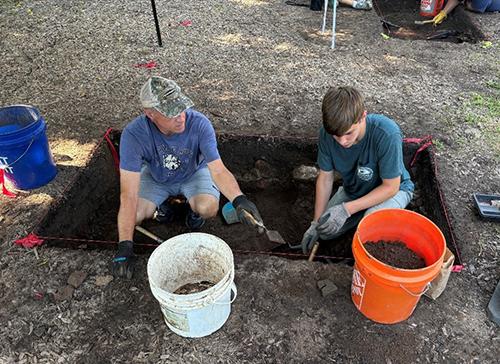
Volunteers help to excavate a test unit stratigraphically.
The Metropolitan Historical Commission (MHC) is a municipal historic preservation agency working to document history, including both historical and cultural resources. We save and reuse buildings, document and preserve archaeological resources, and make the public more aware of the necessity and advantages of preservation in Nashville and Davidson County, Tennessee. The MHC staff includes an archaeologist that oversees archaeology in Nashville on public property and makes recommendations on private property.
The MHC staff archaeologist oversees the Nashville Public Archaeology Program (NPAP) which is dedicated to educating and involving the public and building a culture of support for the preservation of archaeological resources. Volunteers are the driving force behind the NPAP, participating in excavation, documentation, curation, and public outreach.
For more information contact MHC staff archaeologist Dr. Adam Fracchia at [email protected].
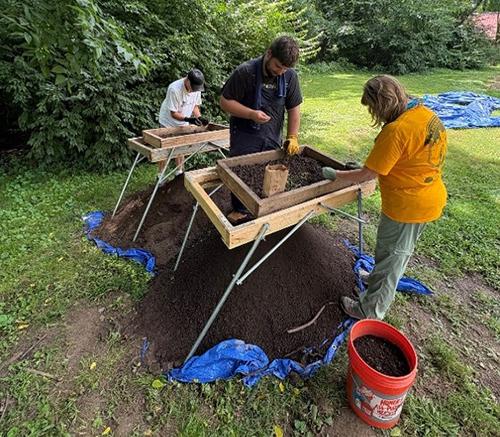
Volunteers and students help to screen soil excavated in a test unit.
Volunteer
We have several exciting ways that the public can participate in preserving Nashville’s heritage. This includes internships and volunteer opportunities in the field and lab. See our Nashville Public Archaeology Program page for more information.
Support our Foundation
The Nashville Historical Foundation (NHF) is a 501(c)(3) nonprofit in Nashville that supports historic preservation, education, and research through programs like Nashville Sites, preservation projects, and community initiatives. The NHF partners closely with the Metropolitan Historical Commission.
Support the Nashville Historical Foundation and preservation efforts across Nashville and Davidson County.
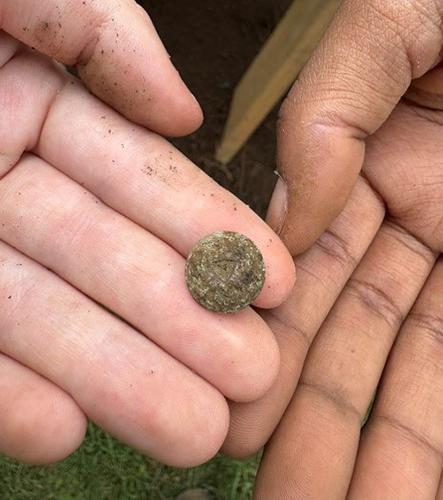
A Union Army uniform button recovered by the high school students helping to excavate at the Sunnyside Mansion.
This survey offers a chance for the public to detail the objects that have been discovered in Nashville. Knowing what objects are found and where they are located is important data that can help us better understand larger site patterns, document Nashville’s history, and help preserve the archaeological record.
The public is encouraged to use the survey below to document artifacts they have found. This information will be shared with the Metropolitan Historical Commission.
Please remember that actively digging or collecting artifacts damages archaeological sites and separates objects from their context which is crucial for understanding and associating artifacts in time and space. If artifacts are found during ground disturbance, please contact the Metropolitan Historical Commission and/or the Tennessee Division of Archaeology.