Overview
The Metropolitan Government of Nashville & Davidson County (Metro Nashville) is actively seeking innovative and sustainable solutions to combat food deserts and improve access to healthy, affordable food for all residents. This request for information (RFI) is a critical step in exploring alternative models to address this pressing issue. We invite feedback, insights, and recommendations from a diverse range of stakeholders, including grocery store operators, non-profit organizations, and developers, to help shape the future of food access in Nashville.
Introduction
In Nashville’s urban core, approximately 25.4% of residents—roughly 128,000 individuals—live in designated food desert areas, where access to a full-service grocery store is more than a half mile walk away. Of those, an estimated 39,000 individuals also live below the poverty line, reflecting the significant overlap between food insecurity and economic hardship. In rural areas, while food deserts affect a smaller percentage of the population, approximately 4,800 residents face similar access barriers, with over 1,100 individuals also experiencing poverty. Altogether, more than 40,000 low-income individuals—representing approximately 6% of Davidson County’s population—live in areas that meet the USDA’s definition of a food desert. These overlapping challenges underscore the need for targeted interventions that address both geographic access and affordability, particularly in historically underserved communities such as North Nashville, Madison, Antioch, Napier-Sudekum, Haynes Manor, and Bordeaux.
Data compiled from 2020 Census Geographies with Decennial Census Attributes and 2023 American Community Survey (ACS) 5-Year Estimates Detailed Tables, joined and analyzed by the Tennessee Geographic Information Systems (GIS) team using block group–level data from Metro Nashville’s organizational data portal.
Food Desert Tracts in the Nashville Metropolitan Area
Visit interactive version of Food Desert Map below
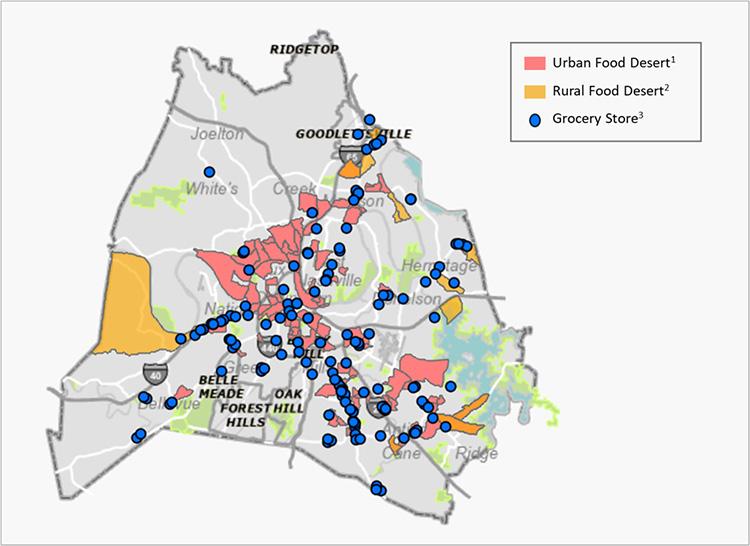
*i. 1. Urban Food Desert was defined as an area with a 20% or higher poverty rate and in which at least 1/3 of the population lives more than 1/2-mile away from a supermarket or grocery store. 2. Rural Food Desert was defined as an area with a 20% or higher poverty rate and in which at least 1/3 of the population lives more than 10 miles away from a supermarket or grocery store. 3. Grocery store was defined as store that sells fresh produce among other staple grocery items, is currently operational, and is open at least 5 days a week during normal operating hours (i.e. not a farmer’s market nor convenience store).
ii. Data compiled from 2020 Census Geographies with Decennial Census Attributes and 2023 American Community Survey (ACS) 5-Year Estimates Detailed Tables, joined and analyzed by the Tennessee Geographic Information Systems (GIS) team using block group–level data from Metro Nashville’s organizational data portal.
Vision
Mayor O’Connell envisions a future where all residents have convenient access to fresh, affordable, and culturally relevant food options within their neighborhoods. To achieve this vision, we aim to establish a network of 5-6 community-focused grocery stores strategically located throughout the city, prioritizing areas currently designated as food deserts. While the efforts of non-profit organizations are invaluable in providing immediate relief to those experiencing food insecurity, they often face limitations in addressing the root causes of food deserts and ensuring long-term food access. Therefore, we recognize the need to address the underlying economic issues that create and perpetuate food deserts. Metro is committed to leveraging its resources, including the potential use of city-owned land, to facilitate the development of grocery stores. Furthermore, the Mayor’s Office is open to exploring various incentive programs to encourage developers and operators to participate in this initiative, creating sustainable and community-focused food access points. These stores are envisioned as community focused initiatives that may involve sourcing directly from local farmers, a food co-op design, or a public-private partnership where a private grocer operates on city-owned land, ensuring sustainable and community-focused food access.
Request For Information (RFI)
Recognizing the urgent need for innovative and sustainable solutions, the Metro Nashville is exploring alternative models for ensuring equitable access to healthy food. One promising approach is the development of a community-focused grocery store, which would prioritize local control, economic empowerment, and community-driven decision-making. This Request for Information (RFI) seeks to gather insights, ideas, and recommendations from qualified organizations and individuals regarding the feasibility, structure, and implementation of city led grocery stores.
This is not a formal request for proposals, but rather an open call for insight to guide Metro’s next steps, identify partnership opportunities, and shape future investments in food access.
Request for Information - Community Focused Grocer Network, full text
To share your perspective and help build a more food-secure Nashville, please respond through the RFI response form: Community Focused Grocer Network.
For more information, contact [email protected].
