Access Management Manual: Draft Release
The Draft Access Management Manual is now available for public review. Send any feedback or questions to Project Manager, Melisa Hayes at [email protected].
The requirements in the manual will not be enforced until the bill has passed; however, they will be encouraged to be followed in the interim.
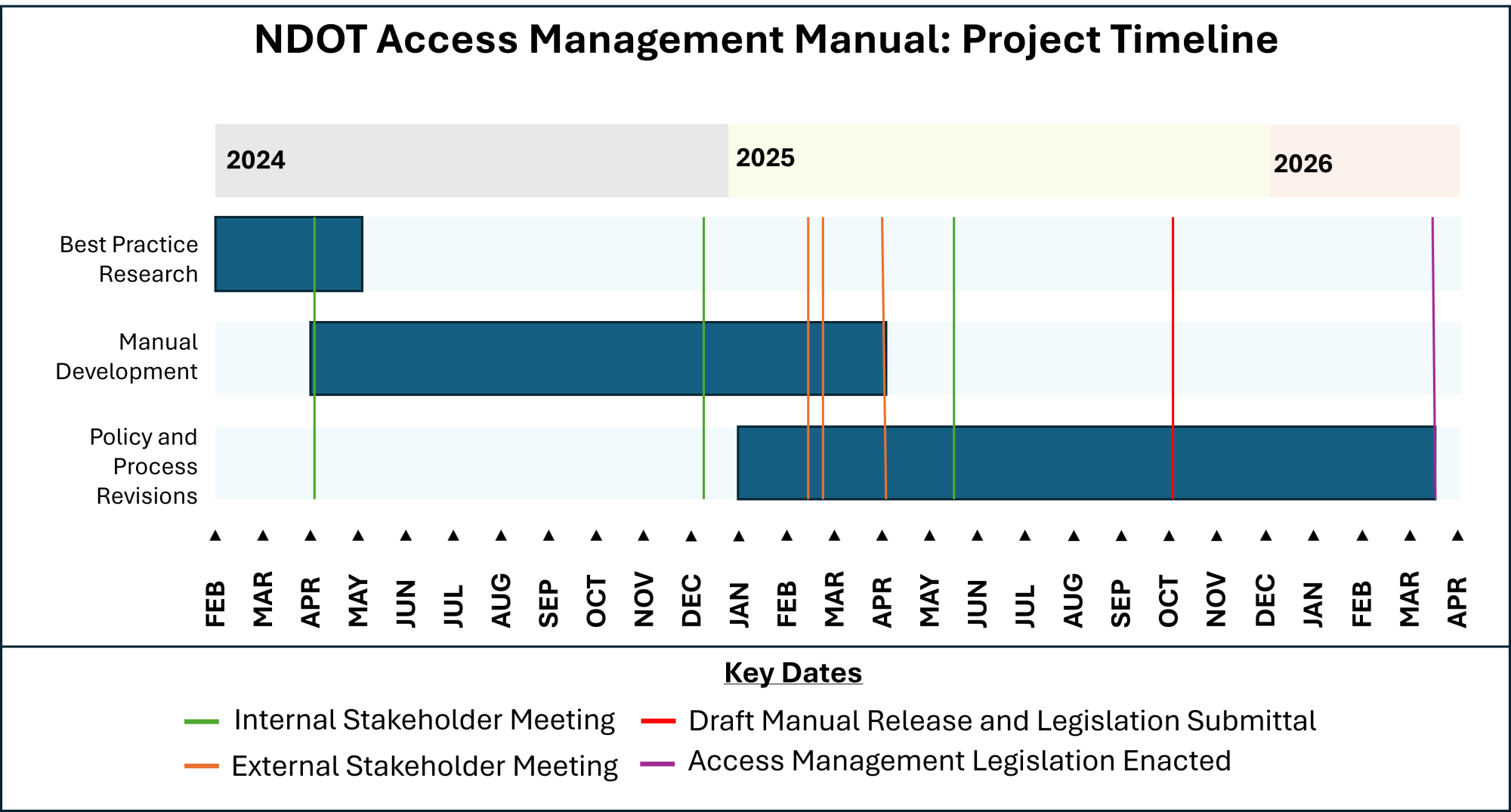
Project Timeline
Timeline Description
Project timeline from February 2024 to April 2026. Three tasks are shown: Best Practice Research, Manual Development, and Policy and Process Revisions. Best Practice Research begins in February 2024 and ends in May 2024. Manual Development begins in April 2024 and ends in April 2025. Policy and Process Revisions began in January 2025 and goes through spring 2026. Three stakeholder meetings are also shown on the timeline. There was an internal stakeholder meeting in April 2024, another internal stakeholder meeting in December 2024, two external stakeholder meetings in February 2025, and one external stakeholder meeting in April 2025. A presentation to the Transportation and Infrastructure Committee was held in June 2025. The draft manual was released and associated legislation was submitted for council reviews in October 2025.
The Nashville Department of Transportation and Multimodal Infrastructure (NDOT) has identified a need to consolidate the codes and policies revolving around access management as well as better align with Tennessee Department of Transportation’s (TDOT) Access Management guidelines. Strategy 2 of Nashville’s Vision Zero Action Plan (2022-2026) is to update roadway design standards and expedite implementation to prioritize safety with action item A-2f stating “Adopt a context-sensitive access management policy, specifically targeting the high injury network (HIN).” With this opportunity to create an Access Management Manual for Nashville and Davidson County, NDOT strives to provide a comprehensive guide that utilizes industry best practice guidance for the design and implementation of safe access to the public right-of-way.
Project Goals
Provide a comprehensive access management resource to support the following activities:
- Ensure appropriate access management strategies are implemented when land is developed.
- Reduce conflict points and improve safety for all road users to align with Vision Zero goals.
- Integrate with the existing transportation plans and policies of Metro Nashville and NDOT.
- Serve as a design resource of best practices for Metro led projects.
Tasks
Tasks involved in the project included:
- Review, comparison, and consolidation of existing access management guidance for Nashville (Code of Ordinances), Tennessee (TDOT Highway Safety Access Manual), and other state and nation-wide technical resources.
- Presentations to both internal and external stakeholders.
- Development of a comprehensive Access Management Manual and align the Metro Nashville Code of Ordinances with legislation.
A review of access management policies from industry best practices, peer city and municipality guidance, and state and local level Tennessee guidance was completed to provide insight and help shape NDOT’s Access Management Manual. To gain insight and a holistic understanding of access management needs in Davidson County, the project team met with six focus groups within Metro including NDOT Development Services, Metro Planning, WeGo Public Transit, Vision Zero and NDOT Planning, WalknBike, and NDOT’s Design and Capital Improvements team.
Best practices were captured from various sources including but not limited to Tennessee Department of Transportation (TDOT) Access Manuals, Transportation Research Board (TRB) Access Management Manual, Federal Highway Administration (FHWA) Manual on Uniform Traffic Control Devices (MUTCD), American Association of State Highway and Transportation Officials (AASHTO) Green Book, TRB Highway Capacity Manual, and National Cooperative Highway Research Program (NCHRP) reports. The analyzed peer cities and municipalities included the following: Charlotte, NC; Fort Worth, TX; Evansville, IN; Florida DOT, Port Authority of New York and New Jersey, Knoxville, TN; and Murfreesboro, TN.
The key access management concepts that were identified throughout the research included multimodal safety, clarity in design standards, flexibility and exceptions, shared access solutions, local adaptions, and integration and consolidation of plans and policies.
Existing Assessment and Best Practices Review for Access Management
Access Management requirements previously were held in the Metropolitan Code of Ordinances in two different chapters; Chapter 13- Streets, Sidewalks and Public Places and Chapter 17- Zoning. Between the two chapters, there was conflicting language and requirements which led to confusion and delays both between Metro Reviewers and developers. In an effort to clarify, expand upon, and consolidate the access requirements into one place, Nashville Department of Transportation and Multimodal Infrastructure (NDOT) pursued the project to create an Access Management Manual for the county. By doing so, the Metro Code of Ordinances needed to be updated.
The subject ordinance amended various provisions of both Chapter 13 and 17. Ordinance amendments include the following:
- NDOT’s Access Management Manual will now hold all access requirements instead of the code.
- Access requirements listed in the code (Chapters 13 and 17) are to be struck and placed in the manual.
- An authorizing statement for the Access Management Manual placed in the code (Chapter 13 and referenced in Chapter 17 as well).
- A statement added into Chapter 13 describing the Access Waiver process.
- Loading requirements were listed in both Chapter 13 and 17, so we are moving the loading requirements in Chapter 13 to Chapter 17, so they are all in one location.
- Parking requirements in Chapter 13 were inconsistent and confusing while the same content reworded was listed in Chapter 17. We have proposed striking these requirements listed in Chapter 13 and leave those in Chapter 17 to eliminate inconsistencies and relieve confusion.
- Public Infrastructure Information for Developers Webpage
- Subdivision Regulations
- Subdivision Street Design Specifications
- NDOT Engineering Details and Specifications
- Multimodal Transportation Analysis Guideline
- Vision Zero Action Plan
- Connect Downtown Action Plan
- Choose How You Move (CHYM) Transportation Improvement Plan
- Nashville Complete Streets Implementation Guide
- Multimodal Access Closure Policy
- Metro Code
- Downtown Code
- Urban Design Overlays
- Nashville Next
- Community Character Manual
- Major and Collector Street Plan (MCSP)
- WeGo Transit Design Guidelines
- nMotion Transit Plan
- TDOT’s Highway System Access Manual (HSAM)
- TDOT’s Roadway Design Guidelines
- TDOT’s Manual for Constructing Driveway Entrances on State Highways
- The Manual of Uniform Traffic Control Devices (MUTCD)
Access Management Manual Project
Why is this update important?
One of the Vision Zero Action Plan's (2022-2026) action items, A-2f, states "Adopt a context-sensitive access management policy, specifically targeting the high injury network (HIN)." With this opportunity to create an Access Management Manual for Nashville and Davidson County, NDOT strives to provide a comprehensive guide that utilizes industry best practice guidance for the design and implementation of safe access to the public right-of-way.
Implementation of the New Access Requirements Questions
When do the requirements go into effect?
The new access requirements will go into effect once the associated bill is approved by council. All new and infill land development submitted to Metro Nashville for plan reviews after the associated bill is approved.
If my site plan was approved prior to the new requirements going into effect, do I have to update my plans?
No, if the site plan was previously approved, you do not have to update.
Code-Related Questions
When was legislation submitted?
October 20, 2025
What is the ordinance bill number?
The ordinance bill was approved by the Traffic and Parking Commission October 2025 and will now be presented to the Metro Planning Commission for approval. The bill will be filed with Metro Council after the Metro Planning Commission approval.
Why was the passage of this ordinance important for the city of Nashville?
This ordinance is important for the city of Nashville to align the code with the new manual and to eliminate existing inconsistencies.
What has changed in the code?
Chapters 13 and 17 of the Metropolitan Code of Ordinances are proposed to be amended with the following changes:
- Access requirements listed in both Chapter 13 and 17 are to be struck and placed into the Access Management Manual.
- An authorizing statement for the Access Management Manual will be placed in Chapter 13 and referenced in Chapter 17.
- A statement describing the Access Waiver process will be added into Chapter 13.
- Loading requirements are currently listed in both Chapter 13 and 17, so it is proposed to relocate the Chapter 13 loading requirements to Chapter 17, so they are all in one location.
- Parking requirements are currently listed in both Chapter 13 and 17 with different phrasing. The Chapter 13 phrasing is confusing, so those are proposed to be struck while leaving the Chapter 17 parking requirements as is.
Manual-Related Questions
Why was a manual created rather than just updating the Metro Code?
A manual was created instead of updating the code in order to provide more detailed guidance along with figures and tables in addition to the access requirements. All access related requirements and guidance were desired to be all in one document to clear up confusion and provide an easy document to utilize.
What is the waiver process if I cannot meet the access requirements?
If access requirements cannot be met, there are two options to follow; a restricted access design could be implemented instead of a full access, or an Access Waiver Form can be filled out and submitted to NDOT's Chief Engineer or his/her designee for review. The Access Waiver Form can be found both in the appendix of the Access Management Manual and on the project webpage.
If the Access Waiver Form is denied approval from NDOT, then a request can be made to the Traffic and Parking Commission to have a deviating access design. The Access Waiver Form with NDOT's filled out response shall be included in the request made to the Traffic and Parking Commission.
Who do I submit a waiver form to and when?
The Access Waiver Form is to be submitted to NDOT's Chief Engineer or his/her designee for review.
The form should be submitted for review as early in the design phase as possible and must be submitted prior to Metro Planning Commission (MPC) or Building Permit (if the project does not have to go to the MPC) applications.
Other Project Questions
How were the peer cities chosen for the existing analysis?
The peer cities/municipalities were chosen because they had specific access requirement guidance and implemented industry best practices. The peer cities reviewed included the following: Charlotte, NC; Fort Worth, Texas; Evansville, Indiana; Florida Department of Transportation; Port Authority of New York and New Jersey; Knoxville, Tennessee; and Murfreesboro, Tennessee.
What do I do if I have more specific questions about the requirements or specific items needed for my project?
Please reach out to Project Manager Melisa Hayes ([email protected]) with additional questions.